
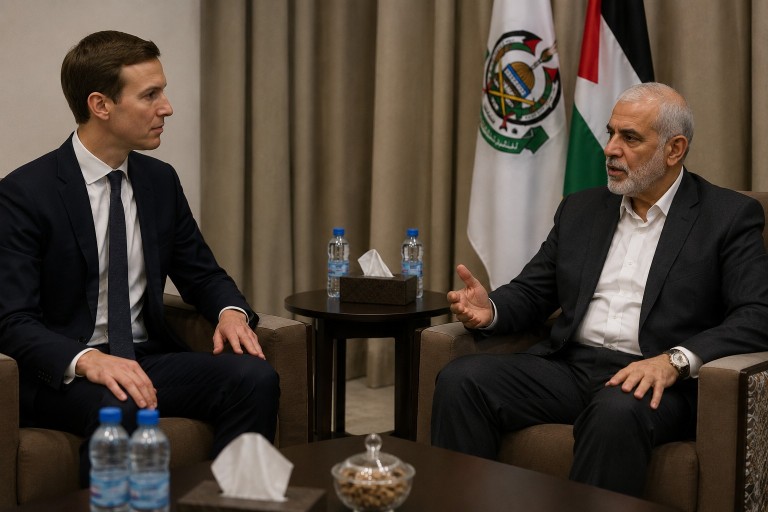
In a renewed push by the United States to revive a stalled Gaza ceasefire plan, Jared Kushner, Donald Trump’s son-in-law and envoy, engaged in discussions with Khalil al-Hayya, the political chief of Hamas, in Egypt on Sunday. This meeting preceded Kushner’s scheduled engagement with Israeli Prime Minister Benjamin Netanyahu, who recently dismissed a US-endorsed 15-point roadmap designed for the next phase of the ceasefire. The roadmap outlines a gradual disarmament of Hamas, an end to Israeli military operations, and a partial withdrawal from Gaza. Additionally, it proposes reconstruction efforts and the deployment of international forces to help maintain security.
Hamas has expressed its commitment to the proposed roadmap but insists on Israel halting attacks and withdrawing to a pre-determined “yellow line” as conditions for implementation. Furthermore, Hamas has linked the surrender of its heavier weaponry to advancements towards establishing a Palestinian state, a concept Netanyahu’s administration opposes. On the other hand, Netanyahu has maintained that a complete withdrawal of Israeli forces from Gaza is contingent upon the full disarmament of Hamas. This stalemate has hindered significant aspects of the ceasefire plan, including reconstruction efforts and the deployment of international forces.
The meeting with Hamas, attended by representatives from Egypt, Qatar, and Turkey, aimed to secure Hamas’s commitment to the plan, especially regarding disarmament, ahead of Kushner’s meeting with Netanyahu. Kushner is set to meet with Netanyahu alongside former British Prime Minister Tony Blair and Board of Peace director Nickolay Mladenov. The diplomatic efforts are being watched closely by several regional nations, including Saudi Arabia, the United Arab Emirates, Jordan, Pakistan, and Indonesia, all of which have criticized Israel’s refusal of the US-backed roadmap and called for swift action to prevent further delays.
This renewed diplomatic initiative comes at a politically sensitive time for Netanyahu, who faces mounting pressure ahead of Israel’s October election. As part of his coalition are ministers advocating for a more aggressive stance on Gaza, casting doubt on the future viability of the ceasefire plan. The outcome of these diplomatic engagements may significantly impact the regional dynamics and the prospects for a lasting peace in the region.